

I spend most of my time building AI systems. The majority of that work goes into engineering tasks, such as connecting different solutions with the appropriate protocols and managing the context for the task at hand. Choosing the actual model takes up only a small fraction of my time.
Often, marketing teams ask me which AI solution is best. Is it Claude, ChatGPT or Copilot? The right model stopped being the variable a while ago. It is the part of your setup you have the least control over and the least reason to worry about. What you control is what the model gets to see and work with.
I have prepared some basic definitions below to help marketing teams understand how to quickly become more sophisticated users of AI.
Q. What does a large language model actually do?
A. It predicts the next word in a sequence, based on the words it has already been given. Everything else you have heard about AI writing, reasoning or planning is built on top of this one operation. In its essence, it’s a giant predictor of words.
All state-of-the-art models come with strong general knowledge. OpenAI, Google and Anthropic have trained them on an enormous spread of human-written text, so they know something about polymer chemistry and something about Renaissance painting and something about your industry. The models improve with every release.
That makes them a commodity in the plain economic sense. Your competitor buys the same quality of model you do, at roughly the same price, on the same day.
Your competitor buys the same quality of model you do, at roughly the same price, on the same day.
Q. What is context?
A. Context is everything the model can see when it answers your query. Your question itself, the files you attached, the examples you pasted, and most importantly the systems you connected to the model.
Marketing teams tend to use the word context to mean only the background material they supply to the AI model. That is one part of it. However, the technical definition covers the whole surface, including the parts that arrive automatically and the parts of the context that you never see.
This distinction matters because it changes what you should be managing.
Since re-training a model is not economically feasible for most companies, managing the context you provide is the most powerful tool you have to ensure quality outcomes.
Q. What is a context window?
A. A context window is the maximum amount of text a model can hold in view at once. Go past it and the earliest material falls out of use.
The size of context windows has grown with each model generation, which is why a document that overwhelmed a system two years ago can easily be pasted or uploaded today. Nowadays, models can process all seven Harry Potter books at once. This has nothing to do with whether you pay for a subscription or not. It is a property of the model itself.
Besides quantity, quality plays a huge role. If you keep information in your context that is unrelated to your task, you degrade the quality of your output. This is a phenomenon known as context rot.
Here’s a practical tip: when a long chat starts producing answers that ignore details you established at the beginning, you’ve likely hit this phenomenon.
Q. What is AI slop?
A. Slop is AI output that reads as competent but says nothing. It often has correct grammar, sensible structure, professional vocabulary and no valuable information. You can frequently spot it by its excessive use of meaningless filler words and the em dash (—) to stretch out sentences.
Most B2B marketing teams that have rolled out a chat tool at scale have produced slop, whether they want to admit it or not. Often, the first drafts pass a skim, but when you actually read the text, well, it needs rewriting. When a colleague does the rewrite, the would-be efficiency gains quickly disappear.
Q. What is a hallucination?
A. A hallucination is a confident statement that the model invented. This includes fake citations, references to customers who do not exist, or specifications that were never published.
The model generates a hallucination the same way it generates a true statement, by predicting plausible words. It has no separate mechanism that checks whether the result is factual.
Slop and hallucination need different defenses. You catch a hallucination by checking the claim against a source. Slop walks straight through that check, because it rarely commits to anything specific enough to be wrong.
What you control is what the model gets to see and work with.
Q. What is domain knowledge?
A. Domain knowledge is what your team knows that the model does not: your brand voice, your terminology, your customers’ actual questions, the reason a decision went one way in 2023 and the other way last quarter. It should be the major part of the context you provide to your model.
Picture a senior marketer joining your company. She brings 20 years of experience and excellent judgement, and on day one she knows nothing about your market or your accounts. The model sits in that position permanently, except it never picks anything up by being exposed to the culture and people.
Q. What is a skill?
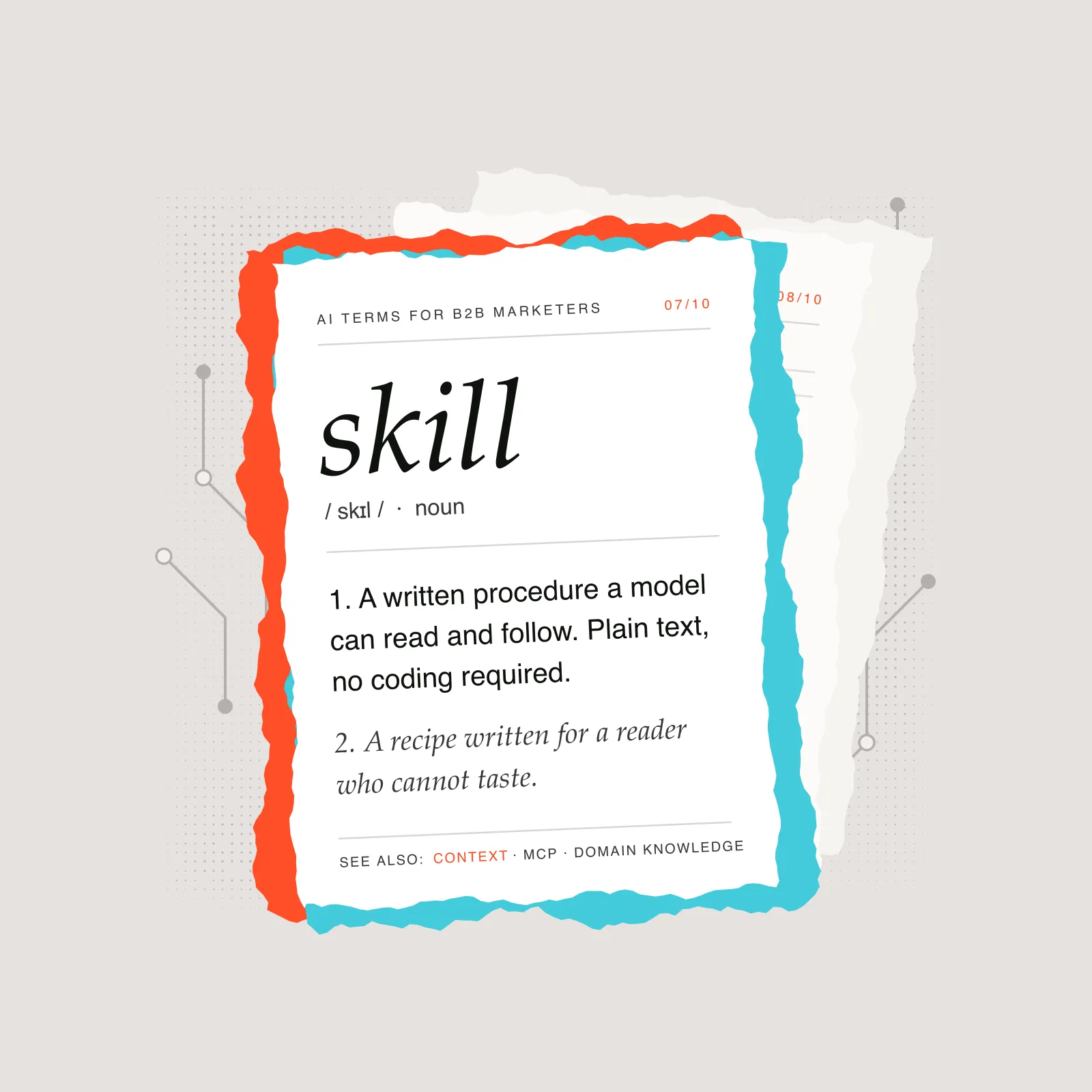
A. A skill is a written procedure a model can read and follow. They are plain text in markdown format, with no coding required.
Skills are not more complicated than emailing an intern a description of a process: Here is what we do, here is the order, here is what good looks like at the end. It is a cooking recipe written for a reader who cannot taste.
The part people find surprising is that the models decide whether or not to use skills. Given a task and a library of available skills, the model can go and fetch the one that fits, then work the procedure into what it produces.
Q. What is context engineering?
A. Context engineering is the work of deciding what a model should see before it answers. It has replaced prompt engineering as the discipline worth building inside a marketing team.
Prompt engineering was about phrasing, and it mattered when models were weaker, had no additional data sources, and were more sensitive to how you asked a question. Newer models are forgiving about phrasing but just as ignorant about your business as the old ones were. That’s why context engineering is so important and prompt engineering has become less important.
Q. What is MCP?
A. MCP, or Model Context Protocol, is a standardized way for an AI system to fetch information from somewhere else while it works.
Many marketing teams struggle with this. MCP gets discussed as though it were the invention that made generative AI possible. Yet it is the pipe. What travels through it decides whether you will have quality output with your AI.
Marketing teams could take skills files, attach them to an email, and ask everyone to paste them in by hand into the AI of their choice. The result would be identical to having the skills accessible through MCP, but the process would collapse at the fourth employee. MCP only enables users to connect external sources efficiently.
Q. What does integrating AI solutions into your existing system mean, and why does procurement care?
A. B2B marketing teams can integrate AI directly into their existing systems. This allows teams to use AI skills natively within the system your company already runs, rather than on a vendor’s platform that your team logs into separately.
This sounds like a technical preference, but it’s very important because this matters to procurement.
If a marketing team wants a new tool and has to acquire a standalone product, this will trigger a full purchasing sequence: due diligence, IT security review, a data protection assessment, GDPR questions, a conversation with the compliance officer, etc.
In my experience with AI rollouts, most of the discussion is not about whether the output is any good. It is about where the models sit, whether they are hosted in the EU or the US, and whether sensitive company data leaves the building.
When the architecture only adds knowledge to a system that has already cleared such reviews, none of these questions get reopened.
Going deeper: the Model Context Protocol from the MCP entry is documented at modelcontextprotocol.io.